

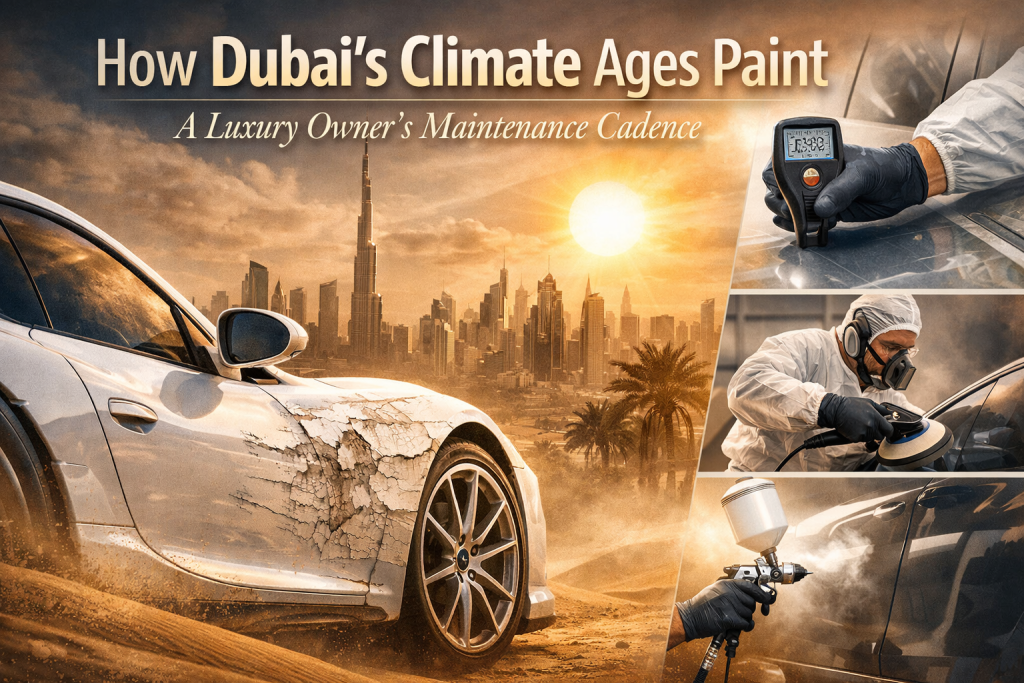
Dubai is unforgiving on automotive paint. Not because owners neglect their cars—but because the environment quietly works against them every single day.
Between extreme UV exposure, prolonged humidity, coastal salt aerosols, and seasonal fog, Dubai’s climate accelerates paint aging far faster than milder regions. This is why Al Quoz has become the city’s detailing nerve center: quiet, dust-managed bays tucked between Sheikh Zayed Road and Al Khail Road, built for precision rather than convenience.
In a city where searches for best car detailing Dubai are about preservation rather than vanity, understanding how the climate degrades paint is the first step toward maintaining it properly.
Why Dubai Ages Paint Faster Than You Expect
Paint degradation in Dubai isn’t caused by dust alone. It’s driven by multiple environmental forces acting at the same time.
UV radiation regularly reaches very high to extreme levels, accelerating photo-oxidation at the surface of the clearcoat. This breaks down protective polymers, scatters reflected light, and slowly dulls gloss—even on relatively new vehicles.
Humidity compounds the issue. For more than half the year, conditions remain muggy or worse. Moisture lingers on panels longer, allowing airborne minerals and pollutants to bond more aggressively to the surface.
Along coastal routes, sea-salt aerosols add another layer of stress. Salt residue is hygroscopic—it attracts moisture—making etching more likely if the surface isn’t cleaned promptly.
Winter introduces a different challenge. Fog deposits moisture mixed with dissolved minerals overnight. If this residue dries under sunlight before removal, it can bake into the clearcoat and leave stubborn marks.
In practical terms, Dubai paint degradation is driven by:
Extreme UV exposure breaks down clearcoat polymers
Sustained humidity increasing chemical bonding of contaminants
Sea-salt aerosols are accelerating etching near coastal routes
Winter fog residue is baking minerals into hot panels


